Finding Calm in the Knots
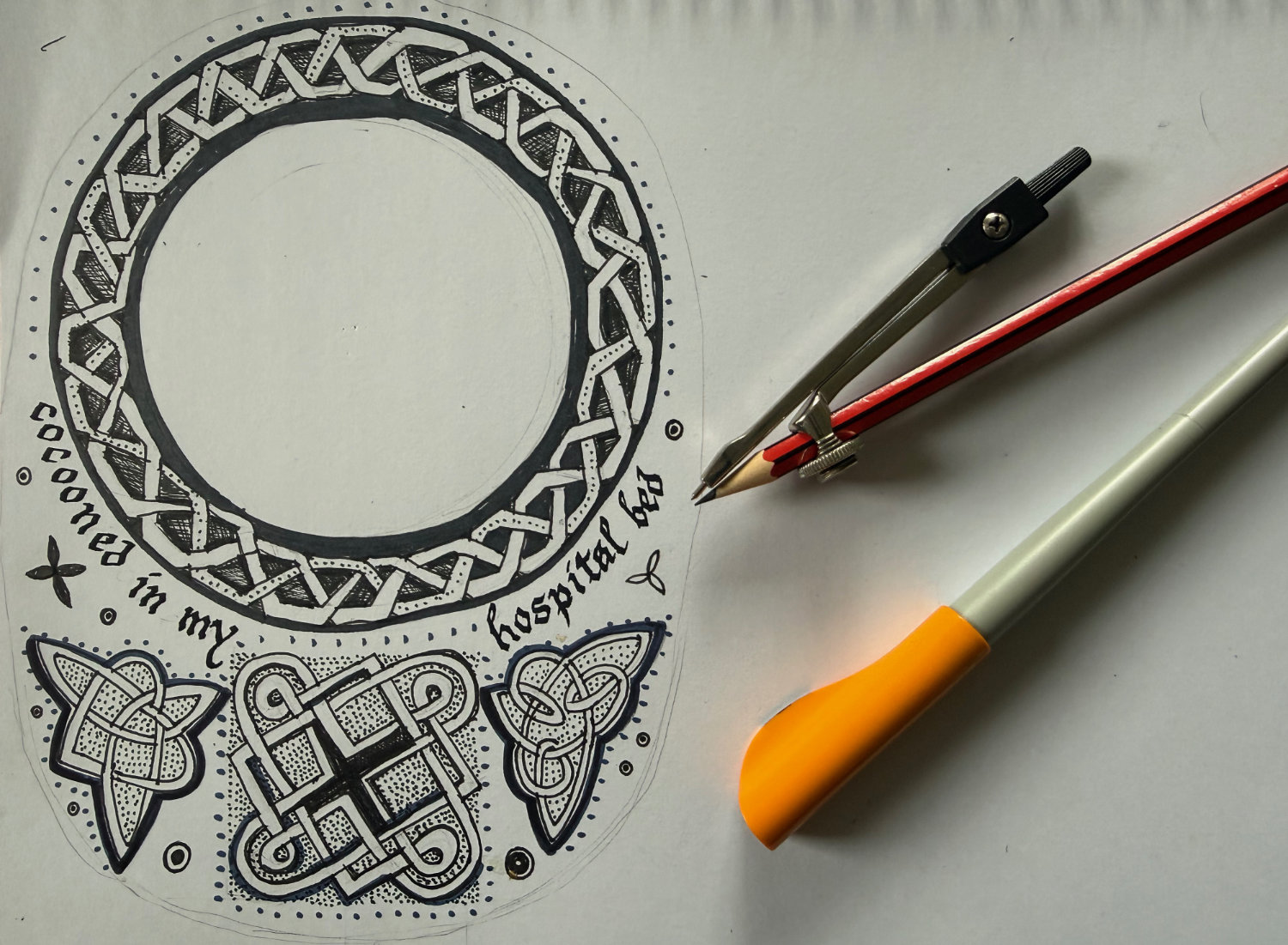
Since my major cancer operation, recovery has been slower and more layered than I expected. I still can’t sit down comfortably for long, and that changes the rhythm of everything — work, rest, creativity. So I’ve been adapting. Lately, I’ve become completely engrossed in designing Celtic knots for my stoma bag cover series, ‘Under Repair.’
What began as a design idea has become something more: a quiet part of my recovery.


There’s something deeply soothing about the repetitive, methodical action of knotwork. Drawing the grid. Following the over-under pathways. Correcting a line. Trying again. When you’re working with your hands in this focused way, your mind gradually softens. You become absorbed. Time shifts. The noise lowers.
I’ve seen this for years in the people I’ve worked with on creative projects — that sense of “flow” when someone is fully immersed. Now I’m consciously using it myself, almost as a form of mindfulness.
There’s also real satisfaction in the process. Celtic knots look intricate and mysterious at first. You have to decipher them, interpret the structure, trust the system. And then, suddenly, your lines meet perfectly and the pattern locks into place. Those tiny sparks of joy matter.

Stress, Cortisol and Why Calm Matters in Recovery
During recovery, your body isn’t just healing physically, it’s also processing shock, fear, uncertainty and change. I heard a recent radio report discussing research into cortisol — the body’s primary stress hormone — and its relationship to anxiety and longer-term health.
Cortisol is part of our natural survival system. It helps regulate inflammation, energy use and our daily rhythms through the hypothalamic-pituitary-adrenal (HPA) axis. In short bursts, it’s protective. But when stress becomes chronic — as it often can during serious illness and recovery — cortisol regulation can become disrupted.
Research published in journals such as Psychoneuroendocrinology and reviews from bodies like the American Psychological Association explain that prolonged stress exposure is associated with anxiety, low mood, sleep disruption and changes in emotional regulation. Long-term dysregulation of stress hormones has also been shown to affect immune function and inflammatory processes.
In cancer research specifically, organisations such as the National Cancer Institute note that stress hormones — including cortisol and adrenaline — interact with tumour biology in complex ways. While stress does not “cause” cancer in a simple, direct sense, chronic stress can influence immune responses and inflammatory pathways that are relevant to disease progression and recovery.
For someone healing from major surgery, that matters.
It reinforces something simple but powerful: learning how to calm the nervous system isn’t indulgent — it’s supportive. It’s part of care.

A Moving Meditation
This is where knot-making has quietly stepped in.
Because I still can’t sit comfortably for long stretches, my practice has adapted. I work in short bursts. I stand. I shift. I return to the pattern. The repetition becomes grounding. My breathing slows. My shoulders drop.
Creative, hands-on activities have been shown to lower perceived stress and support parasympathetic (“rest and digest”) nervous system activity. But beyond the science, there’s the lived experience: the feeling of steadiness that returns when you’re concentrating on something constructive and contained.
The knots feel symbolic too. Interwoven lines. No beginning or end. Strength through structure. Beauty from patience.
Recovery from cancer can feel fragmented — physically and emotionally. Working on something that is structured, continuous and whole feels quietly defiant.
Want to Try It Yourself?
If you’d like to experiment with knot designs, I’ve been using Celtic Design: A Beginner’s Manual by Aidan Meehan. It breaks the patterns down into manageable steps. There are also plenty of online tutorials if you prefer learning visually.
You don’t need to be an artist. You just need a pencil, paper and the willingness to follow the line.
Whether you’re recovering from surgery, navigating anxiety, or simply feeling the pressure of everyday life, small creative rituals can become anchors. Not cures. Not miracles. But steady companions.
For me, these knots are more than decoration. They’re part of healing — one line at a time.

One response to “Creation as Recovery:”
These are fantastic designs. I love the marrying of ancient script with modern medicine, Celtic knots with intestinal interweavings.